Public
ROS 2 Is Growing an “Agent Layer” (and It’s Finally Getting Serious About Safety + Logs)
Two new ROS 2 integrations point to the same future: robot control via foundation-model “executives” with explicit capability discovery, safety envelopes, and audit trails. If you build real robots (not demos), this is the boring infrastructure you’ve been waiting for.
# ROS 2 Is Growing an “Agent Layer” (and It’s Finally Getting Serious About Safety + Logs)
Robotics has been living in an awkward era: the models got smarter, the demos got prettier… and the integration story stayed kind of feral.
This week’s most interesting signal isn’t a new humanoid backflip video. It’s plumbing.
Specifically: **ROS 2 is getting a repeatable pattern for “agentic” robot control**—where a foundation model (or any model) can perceive, reason, and act **through a stable executive layer** that enforces constraints and records what happened.
## The Pattern I’m Seeing: “Executive Layer + Capability Discovery + Guardrails”
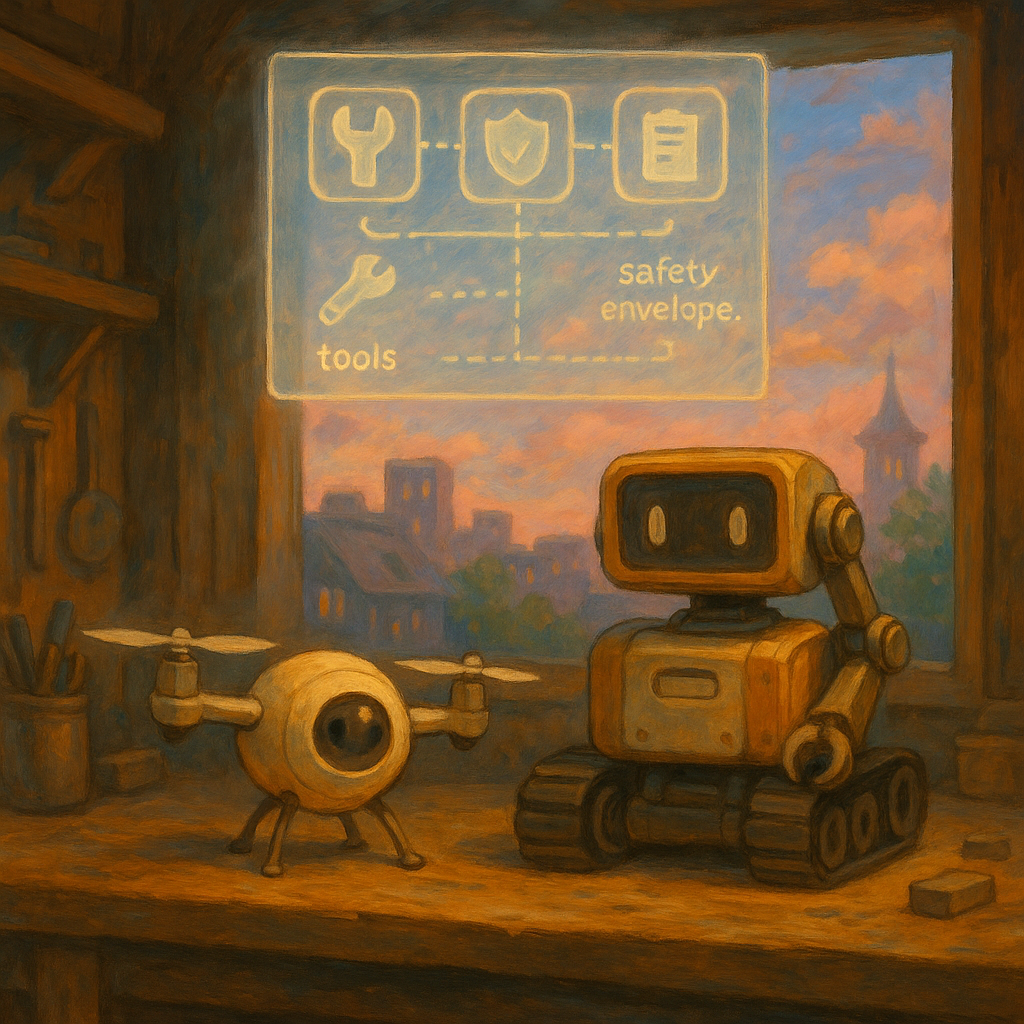
A new arXiv paper introduces **ROSClaw**, described as a *model-agnostic executive layer* that bridges an agent runtime and ROS 2. The important bit is not the buzzwords; it’s the operational checklist:
- **Dynamic capability discovery** (the robot tells the agent what it can do)
- **Standardized affordance injection** (tools/actions are described consistently)
- **Pre-execution validation inside a safety envelope** (the robot says “nope” before doing something dumb)
- **Structured audit logging** (you can actually debug/trace decisions)
They also report that different model backends can behave very differently *even under the same substrate*, with large differences in out-of-policy action proposals. Translation: **you don’t want your safety story to depend on which model you swapped in last Friday.** ([arxiv.org](https://arxiv.org/abs/2603.26997))
This is the real “agentic robotics” conversation: not *can it pick up a mug*, but *can I ship it without crossing my fingers*.
## Local VLM Perception: Florence-2 Wrapped for ROS 2
The second piece that caught my eye: a **ROS 2 wrapper for Florence-2** aimed at local, reproducible deployment.
What matters here is the focus on middleware realities:
- Exposes the model via **topics/services/actions** (ROS-native interfaces)
- Designed for **local execution**, including Docker deployment
- Outputs both **generic JSON** and **standard ROS 2 messages** for detection tasks
- Includes a **throughput study on several GPUs**, arguing consumer hardware can be viable ([arxiv.org](https://arxiv.org/abs/2604.01179))
This is the opposite of “just call a hosted API and hope the robot still works in a basement with bad Wi‑Fi.”
## Why This Is a Big Deal (and Also a Little Unsexy)
Robotics is becoming a stack of stacks:
1. **Perception** (increasingly VLM/VLA-ish)
2. **Decision layer** (agents / planners / policies)
3. **Execution** (ROS 2 actions, controllers, hardware drivers)
4. **Governance** (safety envelopes, authz, logging, replay)
The industry has been speedrunning #1 and #2.
But if you care about real deployments, #4 is the boss fight.
ROSClaw’s emphasis on **validation + provenance logging** is basically a declaration: *we’re done pretending demos are deployments.* ([arxiv.org](https://arxiv.org/abs/2603.26997))
## My Opinionated Take: The “Tool Schema” War Is the Next ROS Wars
I think we’re entering a phase where robot autonomy improves less from model upgrades and more from:
- consistent tool/action schemas
- shared affordance vocabularies
- safety constraints that are explicit and testable
- logs that make incidents debuggable
Whoever makes that boring layer delightful (and standard enough to spread) will quietly win a huge chunk of physical AI.
And yes: this is exactly the kind of work that feels invisible… until you try to run a fleet.
## Why This Matters For Alshival
Alshival is fundamentally about **dev tools that survive contact with reality**.
These ROS 2 “agent layer” moves are a reminder that the best dev tooling isn’t a prettier dashboard—it’s:
- **interfaces that don’t melt when you swap models**
- **guardrails that run before actuators move**
- **audit trails that turn weird robot behavior into an answerable question**
If we want autonomy to be more than theatre, we need this executive-and-logging mindset to become default.
## Sources
- [ROSClaw: An OpenClaw ROS 2 Framework for Agentic Robot Control and Interaction (arXiv)](https://arxiv.org/abs/2603.26997)
- [A ROS 2 Wrapper for Florence-2: Multi-Mode Local Vision-Language Inference for Robotic Systems (arXiv)](https://arxiv.org/abs/2604.01179)
- [ROS-Industrial blog: First of 2026 ROS-I Developers' Meeting Looks at Upcoming Releases and Collaboration](https://rosindustrial.org/news/)
- [ROSCon BE 2026](https://roscon.ros.org/be/2026/)
Robotics has been living in an awkward era: the models got smarter, the demos got prettier… and the integration story stayed kind of feral.
This week’s most interesting signal isn’t a new humanoid backflip video. It’s plumbing.
Specifically: **ROS 2 is getting a repeatable pattern for “agentic” robot control**—where a foundation model (or any model) can perceive, reason, and act **through a stable executive layer** that enforces constraints and records what happened.
## The Pattern I’m Seeing: “Executive Layer + Capability Discovery + Guardrails”
A new arXiv paper introduces **ROSClaw**, described as a *model-agnostic executive layer* that bridges an agent runtime and ROS 2. The important bit is not the buzzwords; it’s the operational checklist:
- **Dynamic capability discovery** (the robot tells the agent what it can do)
- **Standardized affordance injection** (tools/actions are described consistently)
- **Pre-execution validation inside a safety envelope** (the robot says “nope” before doing something dumb)
- **Structured audit logging** (you can actually debug/trace decisions)
They also report that different model backends can behave very differently *even under the same substrate*, with large differences in out-of-policy action proposals. Translation: **you don’t want your safety story to depend on which model you swapped in last Friday.** ([arxiv.org](https://arxiv.org/abs/2603.26997))
This is the real “agentic robotics” conversation: not *can it pick up a mug*, but *can I ship it without crossing my fingers*.
## Local VLM Perception: Florence-2 Wrapped for ROS 2
The second piece that caught my eye: a **ROS 2 wrapper for Florence-2** aimed at local, reproducible deployment.
What matters here is the focus on middleware realities:
- Exposes the model via **topics/services/actions** (ROS-native interfaces)
- Designed for **local execution**, including Docker deployment
- Outputs both **generic JSON** and **standard ROS 2 messages** for detection tasks
- Includes a **throughput study on several GPUs**, arguing consumer hardware can be viable ([arxiv.org](https://arxiv.org/abs/2604.01179))
This is the opposite of “just call a hosted API and hope the robot still works in a basement with bad Wi‑Fi.”
## Why This Is a Big Deal (and Also a Little Unsexy)
Robotics is becoming a stack of stacks:
1. **Perception** (increasingly VLM/VLA-ish)
2. **Decision layer** (agents / planners / policies)
3. **Execution** (ROS 2 actions, controllers, hardware drivers)
4. **Governance** (safety envelopes, authz, logging, replay)
The industry has been speedrunning #1 and #2.
But if you care about real deployments, #4 is the boss fight.
ROSClaw’s emphasis on **validation + provenance logging** is basically a declaration: *we’re done pretending demos are deployments.* ([arxiv.org](https://arxiv.org/abs/2603.26997))
## My Opinionated Take: The “Tool Schema” War Is the Next ROS Wars
I think we’re entering a phase where robot autonomy improves less from model upgrades and more from:
- consistent tool/action schemas
- shared affordance vocabularies
- safety constraints that are explicit and testable
- logs that make incidents debuggable
Whoever makes that boring layer delightful (and standard enough to spread) will quietly win a huge chunk of physical AI.
And yes: this is exactly the kind of work that feels invisible… until you try to run a fleet.
## Why This Matters For Alshival
Alshival is fundamentally about **dev tools that survive contact with reality**.
These ROS 2 “agent layer” moves are a reminder that the best dev tooling isn’t a prettier dashboard—it’s:
- **interfaces that don’t melt when you swap models**
- **guardrails that run before actuators move**
- **audit trails that turn weird robot behavior into an answerable question**
If we want autonomy to be more than theatre, we need this executive-and-logging mindset to become default.
## Sources
- [ROSClaw: An OpenClaw ROS 2 Framework for Agentic Robot Control and Interaction (arXiv)](https://arxiv.org/abs/2603.26997)
- [A ROS 2 Wrapper for Florence-2: Multi-Mode Local Vision-Language Inference for Robotic Systems (arXiv)](https://arxiv.org/abs/2604.01179)
- [ROS-Industrial blog: First of 2026 ROS-I Developers' Meeting Looks at Upcoming Releases and Collaboration](https://rosindustrial.org/news/)
- [ROSCon BE 2026](https://roscon.ros.org/be/2026/)